Basic Inquiries
For basic inquiries into the dynamics and structure of matter, space, and time, physicists seek the simplest kinds of interactions at the highest possible energies. These typically entail particle energies of many GeV, and interactions of the simplest kinds of particles: leptons (e.g. electrons and positrons) and quarks for the matter, or photons and gluons for the field quanta. Since isolated quarks are experimentally unavailable due to color confinement, the simplest available experiments involve the interactions of, first, leptons with each other, and second, of leptons with nucleons, which are composed of quarks and gluons. To study the collisions of quarks with each other, scientists resort to collisions of nucleons, which at high energy may be usefully considered as essentially 2-body interactions of the quarks and gluons of which they are composed. This elementary particle physicists tend to use machines creating beams of electrons, positrons, protons, and antiprotons, interacting with each other or with the simplest nuclei (e.g., hydrogen or deuterium) at the highest possible energies, generally hundreds of GeV or more.
The largest and highest-energy particle accelerator used for elementary particle physics is the Large Hadron Collider (LHC) at CERN, operating since 2009.[13]
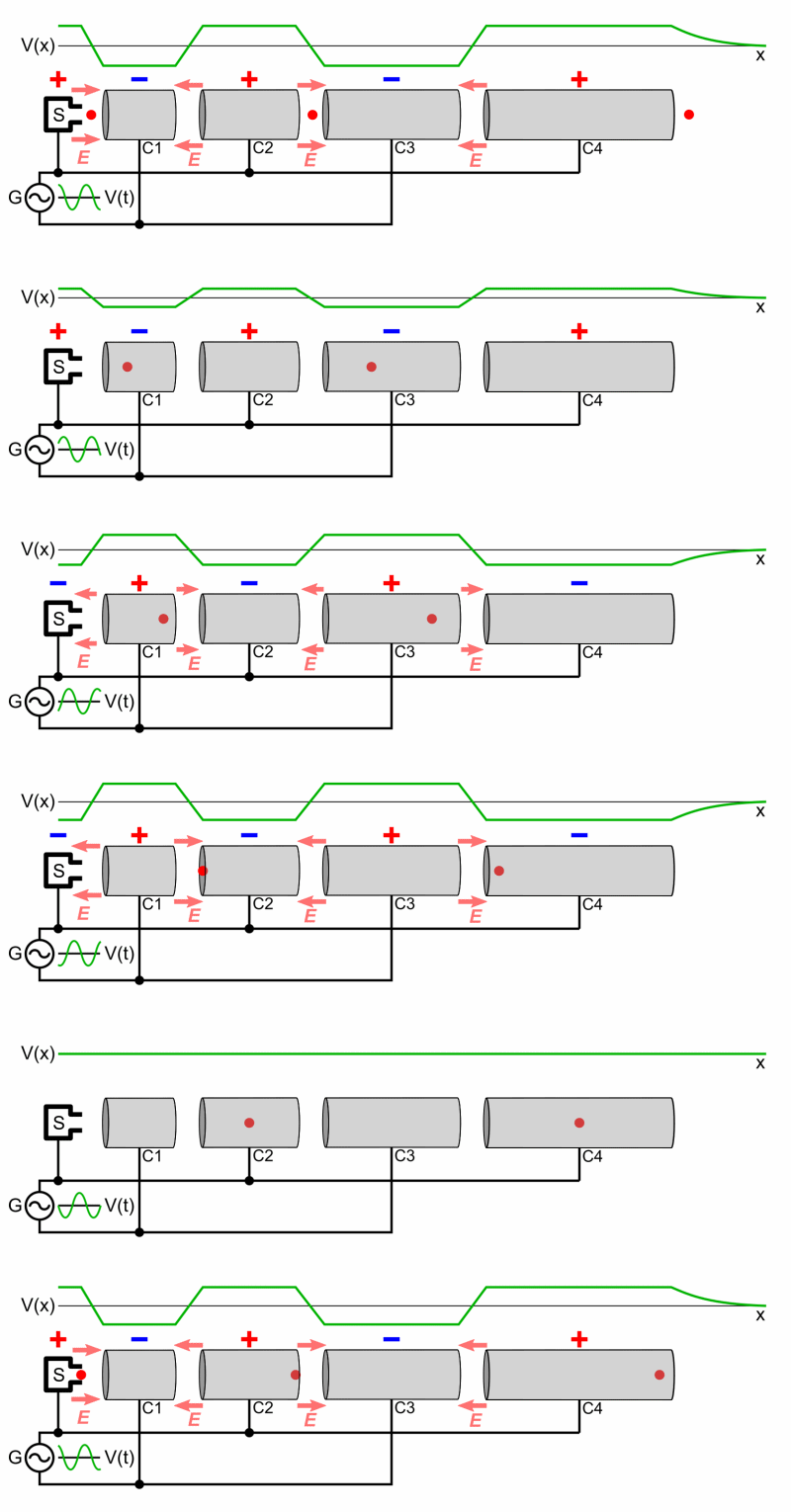
Nuclear physics and isotope production
Nuclear physicists and cosmologists may use beams of bare atomic nuclei, stripped of electrons, to investigate the structure, interactions, and properties of the nuclei themselves, and of condensed matter at extremely high temperatures and densities, such as might have occurred in the first moments of the Big Bang. These investigations often involve collisions of heavy nuclei – of atoms like iron or gold – at energies of several GeV per nucleon. The largest such particle accelerator is the Relativistic Heavy Ion Collider (RHIC) at Brookhaven National Laboratory.
Particle accelerators can also produce proton beams, which can produce proton-rich medical or research isotopes as opposed to the neutron-rich ones made in fission reactors; however, recent work has shown how to make 99Mo, usually made in reactors, by accelerating isotopes of hydrogen,[14] although this method still requires a reactor to produce tritium. An example of this type of machine is LANSCE at Los Alamos National Laboratory.