Particle accelerator
“Atom smasher” and “Supercollider” redirect here. For other uses, see Atom smasher (disambiguation) and Supercollider (disambiguation).
30,000+
Accelerators
80%
Speed of Light
2009
Since
since When?
The largest and highest-energy particle accelerator used for elementary particle physics is the Large Hadron Collider (LHC) at CERN, operating since 2009.[13]
How fast?
An example of an isochronous cyclotron is the PSI Ring cyclotron in Switzerland, which provides protons at the energy of 590 MeV which corresponds to roughly 80% of the speed of light.
Types of Accelerators
There are two basic classes of accelerators: electrostatic and electrodynamic (or electromagnetic) accelerators.[5] Electrostatic particle accelerators use static electric fields to accelerate particles.
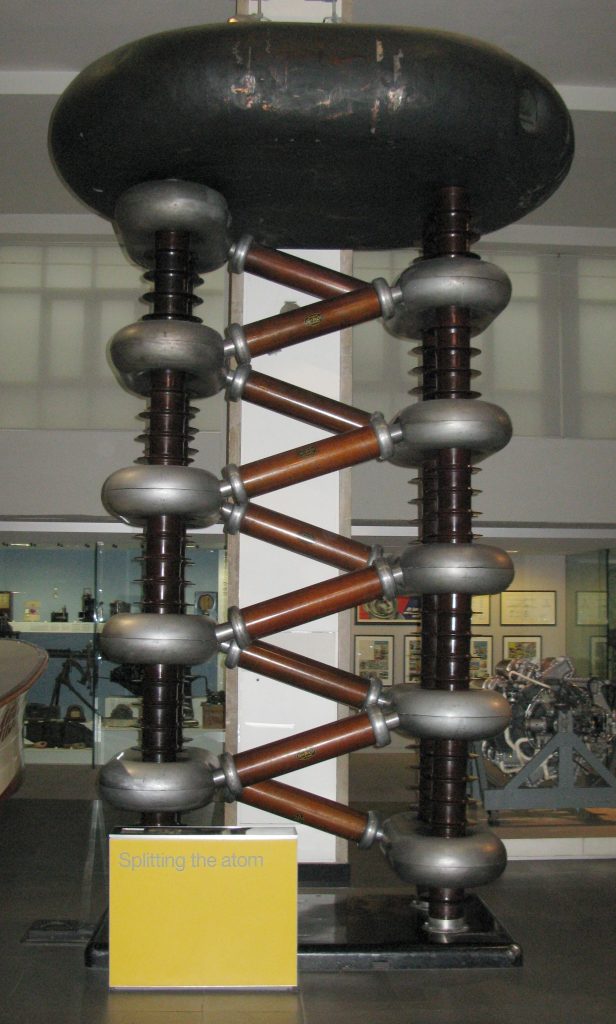
The most common types are the Cockcroft–Walton generator and the Van de Graaff generator. A small-scale example of this class is the cathode-ray tube in an ordinary old television set. The achievable kinetic energy for particles in these devices is determined by the accelerating voltage, which is limited by electrical breakdown.
Electrodynamic or electromagnetic accelerators, on the other hand, use changing electromagnetic fields (either magnetic induction or oscillating radio frequency fields) to accelerate particles. Since in these types the particles can pass through the same accelerating field multiple times, the output energy is not limited by the strength of the accelerating field.
This class, which was first developed in the 1920s, is the basis for most modern large-scale accelerators.
Generator